Guide
What Is Zaratsu Polishing? Grand Seiko's Distortion-Free Mirror Finish, Explained
The short answer
Zaratsu is a hand polishing technique in which a craftsperson presses a watch case against the flat face of a rotating metal disc to produce a mirror surface with no distortion — while keeping the sharp ridge where two planes meet. Grand Seiko states that "only with Zaratsu polishing can the surface of a watch case be made smooth and distortion-free while maintaining the sharpness of the ridge lines."
It is the reason a Grand Seiko case reflects a straight line as a straight line, rather than bending it the way a normal polished case does.
Where the word comes from
Grand Seiko's explanation is specific but incomplete on one point. It says "'Zaratsu' is the Japanese pronunciation of the name of a European company that used to make a polishing machine."
That is as far as Grand Seiko goes on its official pages: it does not name the company. The name Sallaz is very widely repeated across watch media as the origin, and the phonetic path from Sallaz to ザラツ is plausible. But since Grand Seiko does not confirm it in its own materials, it is best treated as a strong and commonly accepted attribution rather than a documented fact from the maker.
The technique itself was first used for Grand Seiko in the 1960s, developed in the design work around the 44GS, launched in 1967, with the 61GS following the year after. Grand Seiko says it remains "central to its case manufacturing today."
What makes it different from ordinary polishing
The difference is geometric, and it is the whole point.
A conventional buffing wheel is a soft, compliant surface. When you press metal into it, the wheel deforms around the workpiece. That produces a shine, but it also rounds off the edges — Grand Seiko notes that buffing "inevitably softens the angle of the ridge" — and it leaves the flat surfaces very slightly wavy.
Zaratsu uses a rotating metal disc with sandpaper attached to it, and the craftsperson holds the case against the disc's face rather than its side. Grand Seiko describes this as a "much more difficult process but it makes the surface of the metal extraordinarily smooth." Because the disc face is hard and flat, the surface it produces is hard and flat too. No compliance means no rounding and no waviness.
| Ordinary buffing | Zaratsu polishing | |
|---|---|---|
| Tool surface | Soft, compliant wheel | Hard, flat rotating disc face |
| Contact | Workpiece sinks into the wheel | Workpiece held against the flat face |
| Flat surfaces | Slightly distorted, wavy reflections | Distortion-free |
| Edges | Softened, rounded | Ridge stays sharp |
Why it is hard
There is no jig doing this. Grand Seiko states that the result depends on "how much pressure is applied to hold the surface against the rotating disc and for how long, and how quickly the surface is slid over the disc," and that "all of this depends on the craftsperson's sense of touch."
Pressure has to increase while the work is completed quickly, all while observing the whole piece. Grand Seiko calls it "perhaps the most challenging and demanding way to finish a watch case because it demands great precision and a deftness of touch that only the human eye can achieve."
Too much pressure in one spot and the flat becomes a subtle curve. Overrun the edge and the ridge you were protecting is gone — and on a case where the whole design language depends on that ridge, the part is finished.
Why Grand Seiko needs it specifically
This is not decoration for its own sake. The Grand Seiko Style — the design grammar established with the 44GS — dictates that a sharp ridge be formed where two planes meet. Flat mirror planes meeting at crisp ridges is the entire look.
That design only works if the planes are genuinely flat. A wavy mirror next to a softened edge reads as ordinary polish. So Zaratsu is not an added flourish on top of the Grand Seiko Style; it is the manufacturing process that makes the style physically achievable.
How to see it yourself
Hold the case under a hard light source with a straight edge nearby — a window frame or a door jamb works.
- On a distortion-free surface, the reflected straight line stays straight as you rotate the case.
- On a conventionally polished case, that reflected line bends and ripples as it crosses the surface.
Then look at where two surfaces meet. A crisp, defined line rather than a soft blur is the ridge Zaratsu exists to protect. Alternating mirror and hairline surfaces on the same case makes both easier to see, because the contrast gives your eye a reference.
Related reading
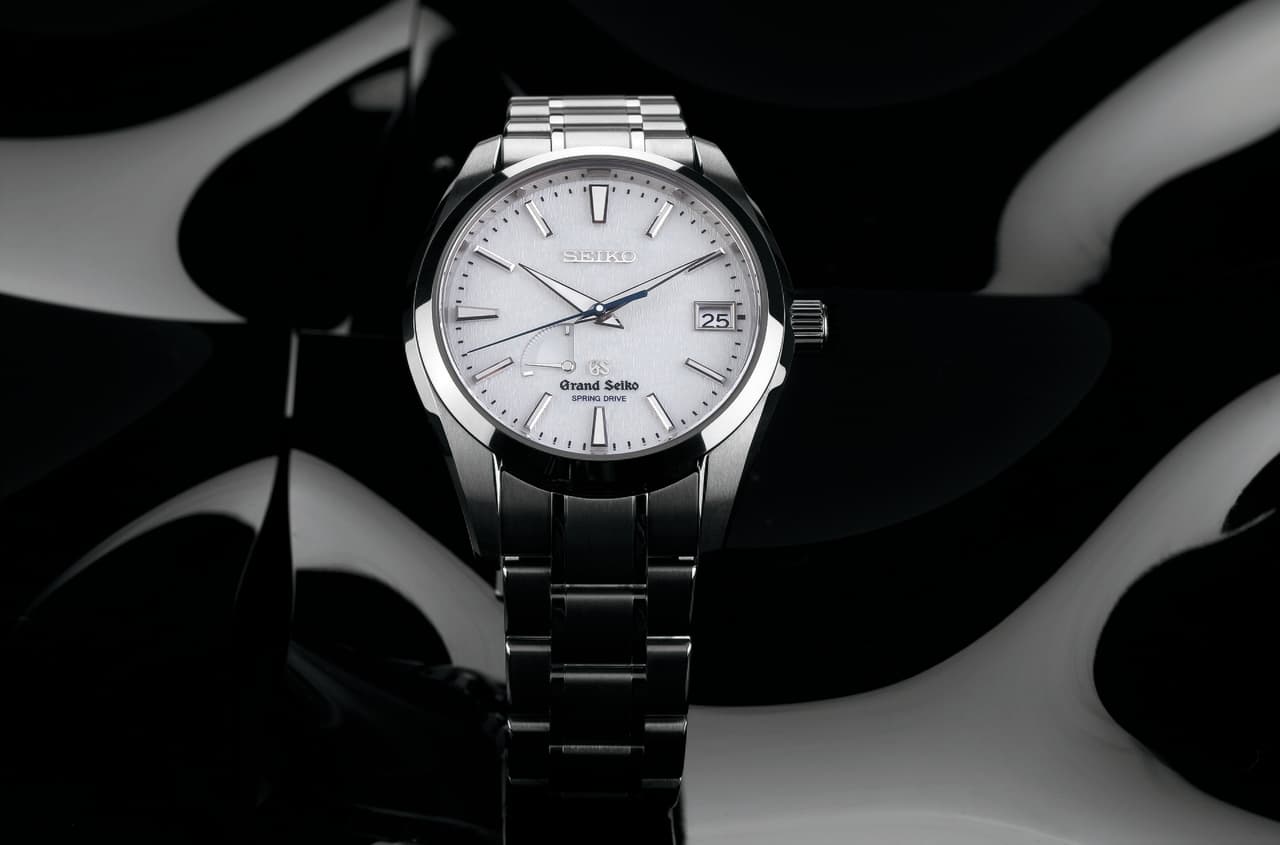
The Grand Seiko SBGA211 Snowflake reference for a worked example of a Zaratsu-finished case, Spring Drive explained for the movement inside many of them, King Seiko vs Grand Seiko for how the finishing tiers differ, and the movement types guide if you are choosing what goes inside the case.
Sources
- Why Zaratsu polishing? | The story of Spring Drive in nine chapters | Grand Seiko (official)
- Chapter 10: Zaratsu polishing, the key to Grand Seiko's "sparkle of quality" | 9S 25th anniversary | Grand Seiko (official)
- Mirrored surfaces, sharp ridges | The 9F and 9S calibres in nine chapters | Grand Seiko (official)
- The Grand Seiko Style | Grand Seiko (official design page)
FAQ
- What does the word "Zaratsu" mean?
- Grand Seiko states it is the Japanese pronunciation of the name of a European company that used to make a polishing machine. Grand Seiko does not name that company on its official pages. The name Sallaz is very widely cited across watch media, but it is not confirmed in Grand Seiko's own materials.
- How is Zaratsu different from normal mirror polishing?
- A conventional buffing wheel is soft, so it deforms around the case, rounding the edges and leaving flats slightly wavy. Zaratsu holds the case against the flat face of a hard rotating disc, so the surface stays truly flat and the ridge between two planes stays sharp. Grand Seiko notes buffing "inevitably softens the angle of the ridge."
- Is Zaratsu polishing done by machine or by hand?
- By hand, against a machine. The disc rotates, but a craftsperson holds and moves the case against it. Grand Seiko says the outcome depends on how much pressure is applied, for how long, and how quickly the surface is slid over the disc — "all of this depends on the craftsperson's sense of touch."
This article is for information only and is not investment, valuation, or authentication advice. Prices, availability and release dates change — always confirm with the retailer or official source linked in the article before buying.